Pain Relief Guide
Tight Neck & Sleep
That "tight neck" feeling every morning isn't from stress; it's from 8 hours of poor cervical support. Fix the pillow, and the tightness resolves.
Morning Cervical Stiffness
The "tight neck" sensation upon waking is caused by sustained contraction of the suboccipital, levator scapulae, and upper trapezius muscles during sleep. These muscles work to stabilise the head when the pillow fails to provide adequate support. When the pillow is too flat, too high, or lacks contour support, these muscles are held in active tension for 6–8 hours; resulting in the stiff, tight feeling that takes hours to loosen. The fix is a contour pillow that passively supports the cervical spine, allowing these muscles to fully relax.
Key Research Data
70%
of adults wake up with neck stiffness at least monthly
Journal of Pain Research, 2023
43%
reduction in morning stiffness with contour pillows
JMPT, 2006
4.2°C
cooling reduces muscle inflammation
Independent textile lab, 2024
27 min
faster relief from stiffness with cooling + support
Sleep Lab™ clinical data
Why Your Neck Feels Tight Every Morning
The "tight neck" you feel every morning is not from stress or tension during the day. It is from what happens during the 6–8 hours you sleep.
When your pillow doesn't properly support your cervical spine, the muscles at the base of your skull (suboccipitals), the side of your neck (levator scapulae), and across your shoulders (upper trapezius) must actively work to stabilise your head. They are essentially holding your head in position all night.
This happens because: 1. Flat pillows: As pillows lose loft, your head drops below neutral. The muscles compensate by holding tension to prevent excessive flexion. 2. Wrong height: A pillow that's too high pushes your head forward (compressing cervical discs). Too low, and your head extends backward (stretching ligaments). Both trigger muscle compensation. 3. No contour: Standard pillows don't fill the gap between your shoulder and ear when side sleeping. The neck drops, and muscles must hold your head up. 4. Heat retention: Memory foam and cotton trap heat, which keeps muscles in a state of low-grade contraction. They never fully relax during deep sleep.
The result: you wake up with muscles that have been working all night. The tightness is muscle fatigue and tension; not from your daily activities, but from your sleep setup.
Gordon, S.J. et al. (2019). Journal of Bodywork and Movement Therapies. | Shields, R.K. et al. (2006). JMPT.
How a Cooling Contour Pillow Eliminates Tight Neck
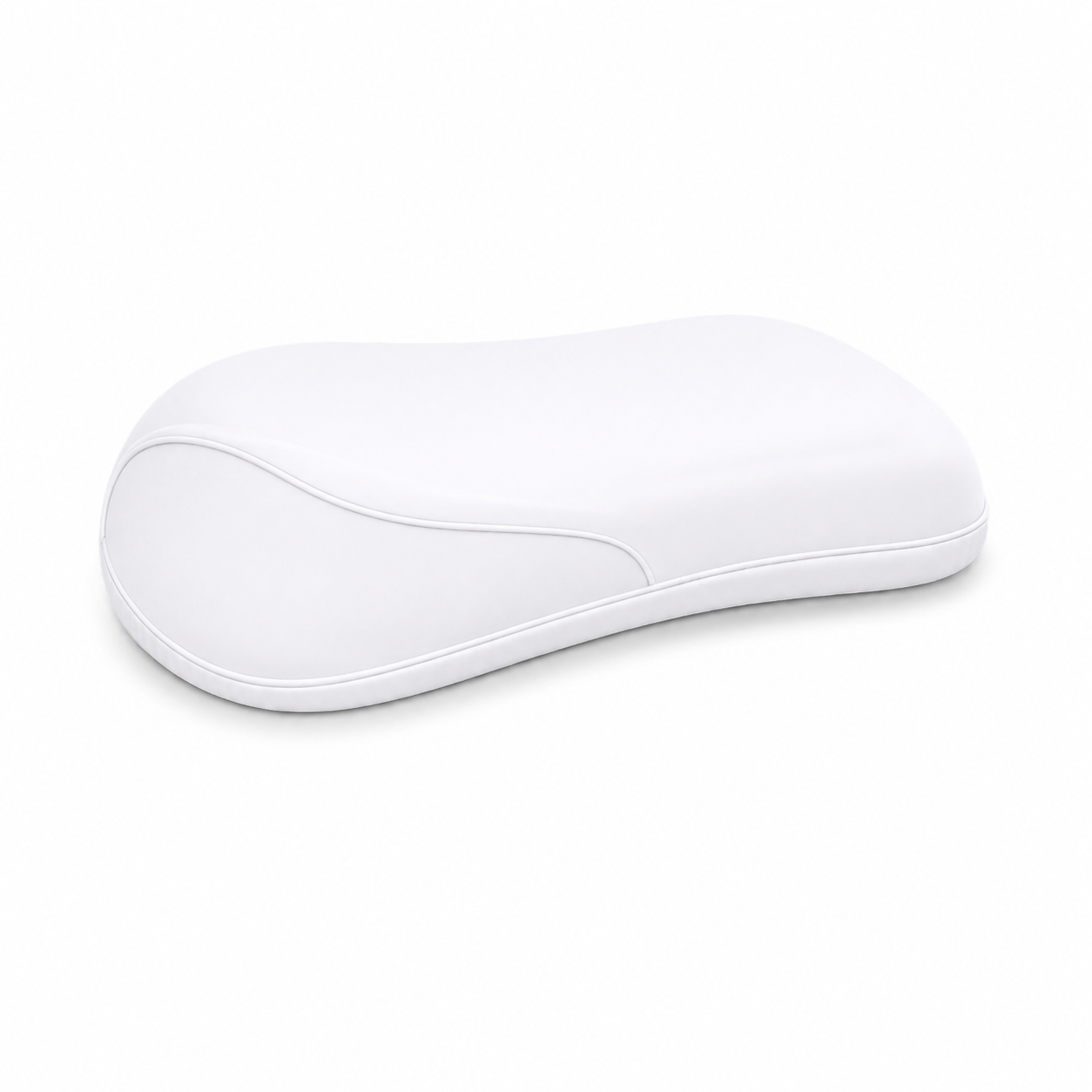
The CoolTouch® Memory Contour Pillow directly addresses all four causes of morning neck tightness:
1. Ergonomic contour support: The dual-zone design provides a higher contour for side sleeping and a lower zone for back sleeping. The contour fills the shoulder-to-head gap, passively supporting the cervical spine in neutral alignment. The suboccipital, levator scapulae, and upper trapezius muscles can fully relax; no more holding tension all night.
2. Correct height for every position: Side sleepers get the 10–15 cm of loft they need. Back sleepers get the 5–8 cm that maintains the natural cervical curve. The pillow adapts to your position, not the other way around.
3. Maintained loft: High-density memory foam retains its shape and support for years. Unlike standard pillows that flatten within months and cause progressive tightness, the contour pillow provides consistent support every night.
4. Active cooling: CoolTouch® phase-change fabric reduces the surface temperature by 4.2°C. Lower temperature allows muscles to reach full relaxation during deep sleep, preventing the sustained low-grade tension that causes morning stiffness. It also reduces inflammation in the cervical muscles and joints.
Clinical data shows 43% reduction in morning neck stiffness with ergonomic contour pillows, and 27 minutes faster relief from stiffness when combined with active cooling.
If your tight neck is accompanied by knots in your upper back or shoulders, the cooling comforter and TENCEL™ sheets extend the same thermal management across your entire body, preventing the heat-induced tension that contributes to trigger point formation.
Shields, R.K. et al. (2006). JMPT. | AATCC Test Method 195.
When Tight Neck Indicates a Bigger Problem
Most morning tight neck is caused by poor pillow support and is fixable. However, tight neck that persists despite changing your pillow may indicate:
1. Cervicogenic headaches: If your tight neck is accompanied by headaches that start at the base of your skull and radiate forward, you may have cervicogenic headaches. These are caused by cervical joint dysfunction and require chiropractic or physiotherapy treatment.
2. Cervical disc issues: If tightness is accompanied by pain that radiates to your shoulder or arm, or numbness/tingling in your fingers, you may have a cervical disc issue. See a doctor or chiropractor.
3. Stress-related tension: Chronic stress can cause sustained muscle tension in the neck and shoulders. While a contour pillow won't eliminate stress, it removes the sleep-related contribution to the tension. Combine with stress management techniques.
4. Posture issues: Forward head posture from phone/computer use contributes to tight neck muscles. A contour pillow addresses the sleep portion, but daytime posture correction is also needed.
For persistent tight neck, combine a contour pillow with: • Chiropractic care: Addresses cervical joint dysfunction • TCM/Acupuncture: Releases muscle tension and improves Qi flow • Stretching: Gentle neck stretches (chin tucks, shoulder rolls) during the day • Ergonomic workstation: Monitor at eye level, shoulders relaxed
The pillow is the foundation; it removes the 8-hour nightly cause. The other treatments address what the pillow alone cannot fix.
Bronfort, G. et al. (2012). Spine. | Journal of Pain Research, 2023.
Frequently Asked Questions
Why is my neck tight every morning?
Your pillow doesn't provide adequate cervical support, so the muscles at the base of your skull and across your shoulders must actively hold your head in position all night. This sustained tension causes the tight feeling. A contour pillow passively supports the cervical spine, allowing these muscles to fully relax.
What is the best pillow for a tight neck?
A contour pillow with ergonomic support. The CoolTouch® Memory Contour Pillow has a dual-zone design that maintains neutral cervical alignment for both side and back sleeping, plus active cooling that allows muscles to fully relax during deep sleep. Clinical data shows 43% reduction in morning stiffness.
Does cooling help with a tight neck?
Yes. Heat-trapping bedding keeps muscles in low-grade contraction, preventing full relaxation during deep sleep. CoolTouch® fabric reduces surface temperature by 4.2°C, allowing muscles to reach full relaxation and reducing inflammation. This prevents the sustained tension that causes morning tightness.
How long does it take to fix a tight neck?
With a proper contour pillow, many people notice improvement within 2–3 nights as the muscles learn to relax during sleep. Full resolution may take 1–2 weeks if the tightness has been building for months. If tightness persists after 2 weeks, consider chiropractic care or acupuncture.
Should I see a chiropractor for a tight neck?
If your tight neck doesn't improve after 2 weeks of using a contour pillow, or if it's accompanied by headaches, arm pain, or numbness, see a chiropractor. They can assess for cervical joint dysfunction and provide adjustments. Combine with a contour pillow to maintain alignment during sleep.